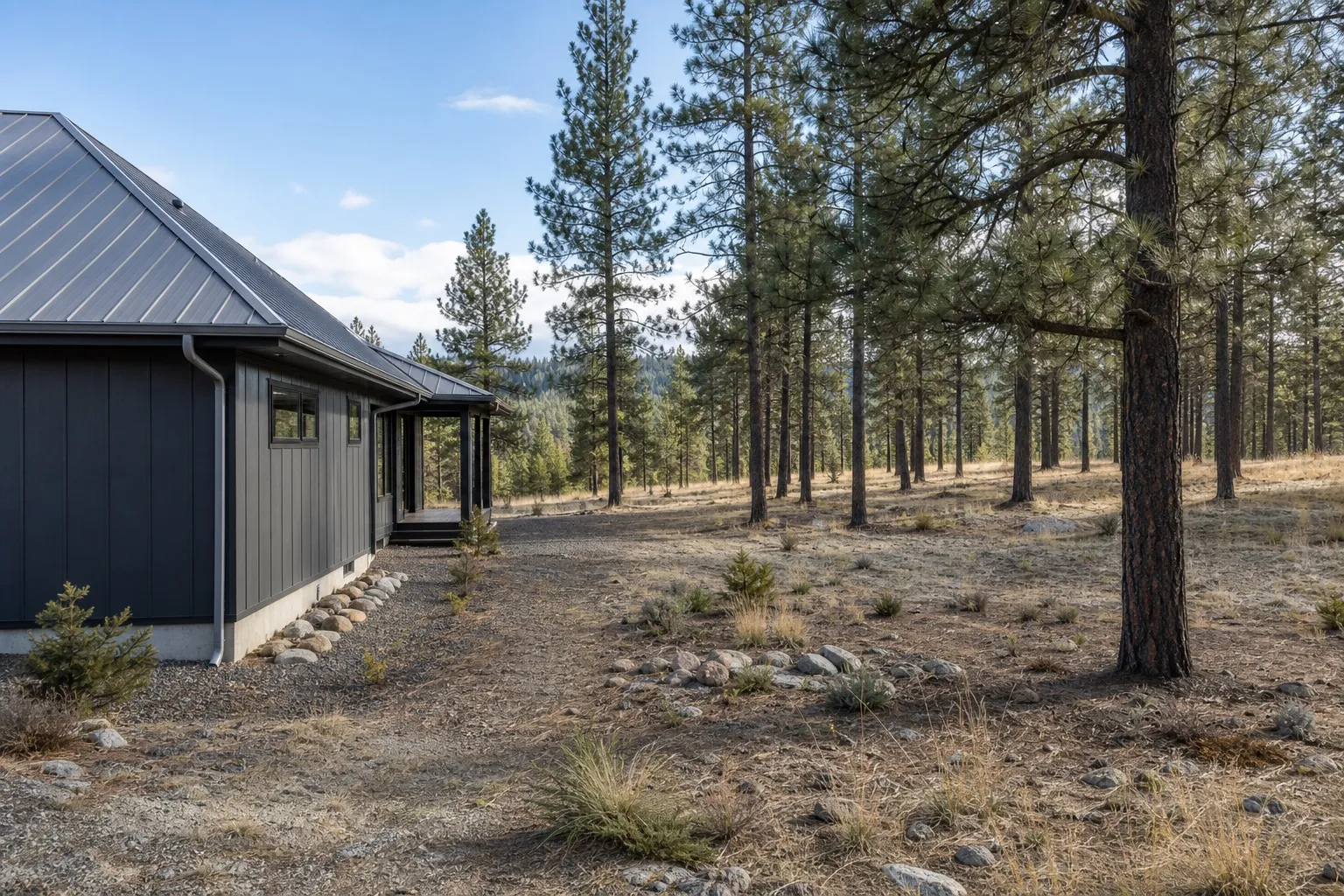
At a glance
- Work from the home outward. The first 5 feet deserve detailed attention before distant acreage is treated.
- Think in connected fuel paths, not one universal clearing radius. Slope, vegetation, structures, and neighboring fuels change the plan.
- Include roofs, decks, fences, outbuildings, access, addresses, firewood, and propane in the same inspection.
- Defensible space is maintained condition, not a one-time clearing project.
Use home ignition zones as a planning framework
Defensible space is the managed area around a building where fuels and maintenance are arranged to reduce the chance of ignition. It does not mean scraping a property bare. It means removing obvious fuel connections, creating separation, and choosing vegetation that can be maintained over time.
The National Fire Protection Association organizes this work into three home ignition zones: immediate, intermediate, and extended. These distances are a useful starting framework, not a substitute for a property assessment. Buildings, decks, fences, slope, wind exposure, plant arrangement, and fuels on adjoining parcels can change what deserves attention first.
| Zone | Planning distance | Primary job | Typical observations |
|---|---|---|---|
| Immediate | 0 to 5 feet | Remove combustible connections touching or immediately beside the building | Needles, leaves, wood mulch, shrubs, stored items, deck debris, attached fences |
| Intermediate | 5 to 30 feet | Create breaks between grasses, shrubs, low limbs, and structures | Ladder fuels, dense planting beds, unmanaged grass, firewood, small conifers |
| Extended | 30 to 100 feet and sometimes farther | Interrupt fire movement and reduce heavy accumulations | Crowded understory, deadfall, saplings, slash, tree-to-tree fuel continuity |
Start with the structure and the first 5 feet
Embers can collect in the same places that collect needles and leaves: roof valleys, gutters, deck gaps, corners, vents, beneath steps, and along the base of walls. The close-in inspection should therefore include the building itself as well as the landscaping. Cutting brush farther out does not correct a combustible mat beside siding or debris trapped under a deck.
Walk slowly around every connected part of the structure. An attached wood fence, privacy screen, trellis, stair, or deck can extend a fuel path directly to the home. Detached sheds and garages need their own close-in inspection because they can receive embers and expose the main structure.
Remove needles, leaves, and combustible debris from the roof, gutters, valleys, corners, decks, and stairs.
Check vents and openings for damage and confirm that screening follows current local guidance.
Move firewood, lumber, outdoor cushions, and other combustible storage away from the building during fire season.
Replace or relocate combustible mulch that touches siding, deck posts, or other vulnerable building components.
Separate shrubs, ornamental grasses, and low branches from siding, windows, eaves, and attached wood features.
Inspect beneath decks and stairs instead of treating only the visible perimeter.
Break fuel connections from 5 to 30 feet
The intermediate zone is where landscape arrangement matters. The goal is not a fixed plant count. The goal is to prevent grass, shrubs, small trees, and low branches from forming an uninterrupted path to the structure. Pruning, selective removal, mowing at safe times, and separating plant groups can create that interruption while retaining shade and a deliberate landscape.
Pay special attention to ladder fuels. Dry grass beneath a shrub, a shrub beneath low conifer branches, and crowded young trees beneath mature ponderosa pine can connect surface vegetation to taller fuels. Removing dead material and pruning selected lower branches can be more appropriate than removing every mature tree.
Plant labels such as fire-resistant do not make a landscape maintenance-free. Washington DNR's Eastern Washington plant guide emphasizes plant placement, condition, and maintenance. Any plant can become combustible when it is dead, dry, crowded, or filled with debris.
- Keep grasses and weeds maintained before they cure and create continuous fine fuels.
- Remove dead shrubs, dead branches, volunteer conifers, and accumulated needle beds where they connect fuel layers.
- Prune for separation without damaging tree health or leaving unstable trees.
- Relocate woodpiles and avoid placing them beneath decks, next to sheds, or against the home.
- Treat propane and other fuel-storage areas according to supplier, fire-code, and local guidance.
Reduce heavy and continuous fuels farther out
Beyond the maintained landscape, many Spokane-area parcels transition into dry grass, brush, young conifers, or wooded understory. This is often where selective thinning, pruning, brush clearing, forestry mulching, chipping, or hand work becomes useful. The treatment should create discontinuity while retaining healthy trees and the character the owner values.
Conditions vary sharply across a single parcel. Rocky benches, steep draws, open pine stands, field edges, and dense regeneration may require different methods. Mark treatment units rather than describing the whole project only by acreage. Also decide what happens to the cut material. Piles, slash, chips, and masticated material are part of the fuel plan, not an afterthought.
A planning-level hazard map can help explain regional conditions, but Washington DNR states that its map should be used with local knowledge and site-specific assessment. It cannot identify every structure-level vulnerability or prescribe work for an individual parcel.
Include access, addresses, outbuildings, and utilities
A defensible-space plan should work as a property system. Long driveways, narrow gates, tight curves, low branches, soft shoulders, and missing turnaround space may affect both maintenance equipment and emergency access. Do not promise emergency-vehicle clearance from a generic measurement. Ask the local fire district what dimensions and vegetation clearances apply to the road or driveway.
Make the address visible from the normal approach in daylight and darkness. Inspect detached garages, barns, shops, well houses, propane locations, utility corridors, and fence lines as separate treatment areas. Where overhead lines or energized equipment are involved, use the utility or a qualified professional rather than treating the corridor as ordinary brush work.
Confirm that the property address is reflective, legible, and visible from both directions where appropriate.
Identify gate width, overhead clearance, bridge or culvert limits, and turnaround constraints before equipment arrives.
Walk around every outbuilding and remove debris or fuel connections at its walls, steps, and roof edges.
Mark wells, septic components, buried utilities, irrigation, propane lines, and other no-travel areas.
Discuss roadside and driveway vegetation with the local fire district when access is a concern.
Use a seasonal maintenance rhythm
A completed treatment starts a maintenance cycle. Needles fall, grass cures, branches break, and seedlings return. A realistic plan separates tasks the owner can repeat from equipment work or arborist work that may occur less often. The frequency depends on the property, weather, vegetation response, and treatment objective.
Avoid creating a rigid calendar that ignores current restrictions and fire conditions. Before mowing dry vegetation, operating spark-producing equipment, chipping, or burning debris, check current Washington DNR, county, fire-district, and equipment-use restrictions. Outdoor burning is not a default disposal method.
| Timing | Owner inspection | Potential project work |
|---|---|---|
| Spring | Clear winter debris; inspect roofs, gutters, vents, decks, addresses, and access | Plan pruning, thinning, chipping, or mulching before peak fire conditions |
| Early summer | Manage grass and new growth while conditions allow safe work | Complete priority fuel breaks and material handling |
| Fire season | Remove new accumulations; keep access and close-in zones maintained | Follow all restrictions and postpone work that can ignite dry fuels |
| Fall | Remove fresh needle and leaf accumulations; note regrowth and storm damage | Review what needs retreatment in the next work window |
Know when to ask for local help
Homeowners can handle many recurring cleanup tasks, but not every decision should be improvised. Hazard trees, work near utilities, steep slopes, complex forest-health questions, and large equipment operations call for the appropriate professional. A mitigation contractor, consulting forester, arborist, utility, or fire-district representative may have different roles on the same property.
Spokane Conservation District advertises wildfire risk assessments and forestry assistance for eligible Spokane County landowners. Washington DNR's Wildfire Ready Neighbors program also serves Spokane County and offers individualized planning and consultation resources. Availability, eligibility, and cost-share terms can change, so confirm current program details directly with the agency before relying on them in a project budget.
| Question | Useful starting point |
|---|---|
| Home ignition-zone priorities | Local fire district, Spokane Conservation District, or Wildfire Ready Neighbors |
| Forest health and stand treatment | Service forester or qualified consulting forester |
| Tree condition near a structure | Qualified arborist |
| Vegetation near energized lines | Serving utility or its authorized vegetation contractor |
| Clearing, mulching, chipping, and material handling | Qualified mitigation or land-clearing contractor with a written scope |
Use this property walk-through checklist
Complete the walk from the structure outward, then repeat it for detached buildings. Photograph uncertain areas and mark them on an aerial image or parcel sketch. The result should be a prioritized work list, not simply a list of everything that could be cut.
Roof, gutters, vents, eaves, siding, windows, decks, stairs, and attached fences inspected.
Combustible debris and storage in the first 5 feet identified for removal or relocation.
Grass, shrubs, saplings, and low limbs that create ladder fuels marked.
Firewood, propane, lumber, trailers, and outdoor storage included in the plan.
Outbuildings, driveway, address visibility, gates, curves, and turnaround inspected.
Priority trees and vegetation to retain clearly identified.
Utilities, septic, wells, property lines, slopes, rocks, and sensitive areas marked.
Material outcome chosen for brush, limbs, chips, logs, and slash.
Owner maintenance tasks separated from contractor or specialist work.
Current agency guidance, restrictions, and assistance programs checked.
Official sources and further reading
Agency programs, restrictions, maps, and requirements can change. Follow the linked source for current details and ask the responsible agency for property-specific guidance.
- How to Prepare Your Home for WildfiresNational Fire Protection Association
- Firewise and Defensible SpaceWashington State Department of Natural Resources
- Build Your Wildfire Ready PlanWashington State Department of Natural Resources
- Wildfire Preparedness and Landowner AssistanceSpokane Conservation District
- Fire-Resistant Plants for Eastern WashingtonWashington State Department of Natural Resources
- Wildfire Hazard and Risk MappingWashington State Department of Natural Resources