At a glance
- Forestry mulching cuts and rearranges vegetation into surface material. It does not remove all biomass from the site.
- Hand and compact-equipment clearing usually provide more control near buildings, utilities, fences, landscaping, and tight access.
- Many strong scopes combine methods by treatment area instead of choosing one machine for the entire parcel.
- Compare proposals by boundaries, retained vegetation, residue, finish, and exclusions, not only by acreage or machine hours.
Define the outcome before choosing the equipment
Forestry mulching and brush clearing are treatment methods, not finished objectives. A useful objective sounds like this: reduce brush and small-tree continuity beneath retained ponderosa pine, preserve marked screening, keep equipment outside the septic area, and leave a maintainable surface. Once the outcome is clear, the method becomes easier to select.
USDA Forest Service research describes fuel treatment as a combination of methods that may include thinning, mastication, chipping, removal, and prescribed fire where authorized and professionally managed. The effectiveness of any method depends on the fuels, arrangement, treatment scale, timing, and maintenance. A machine name alone cannot describe those conditions.
Compare the main treatment options
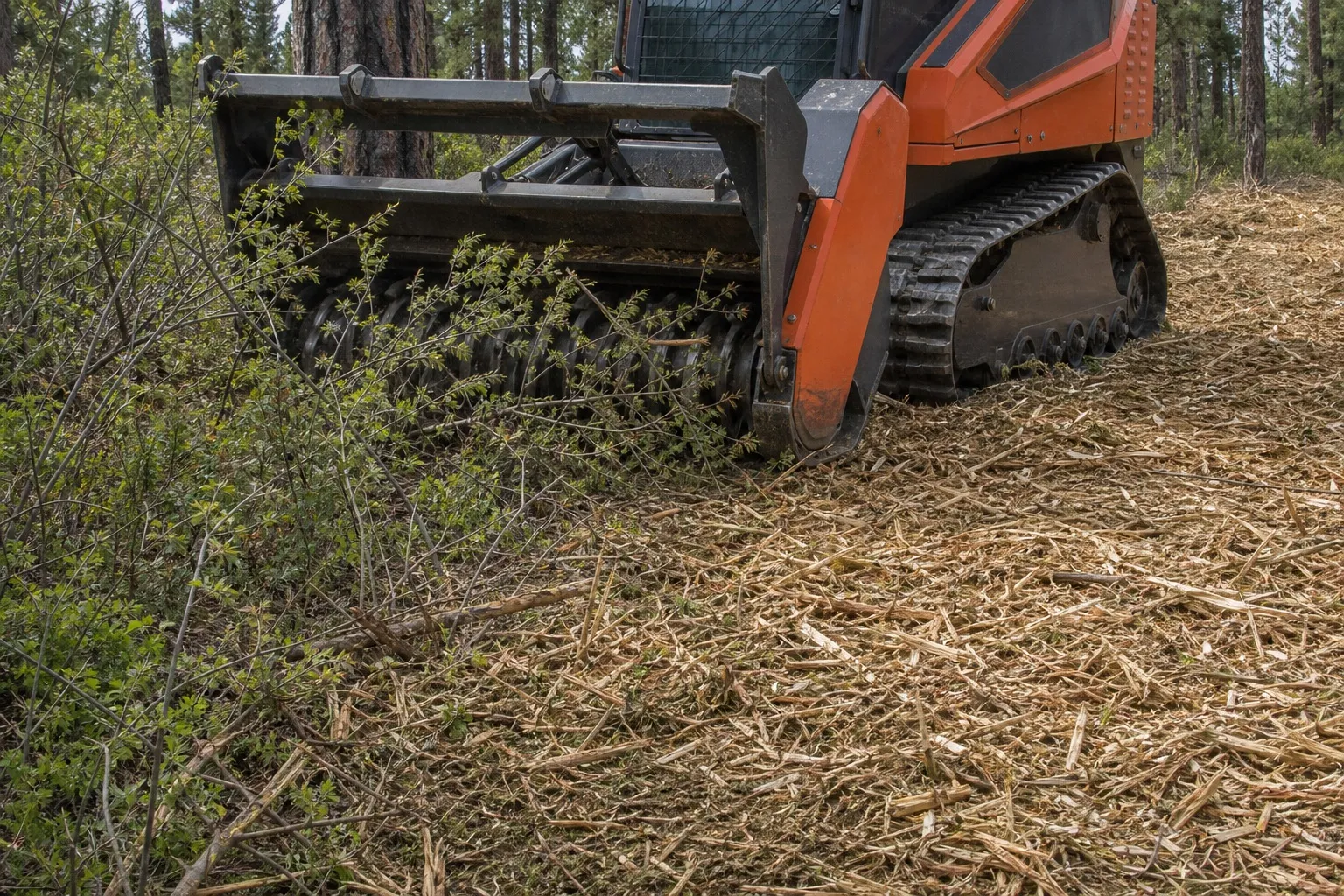
Forestry mulching uses a carrier and cutting head to fragment standing or down vegetation. Brush clearing is a broader term that can include hand cutting, saw work, compact equipment, grubbing, chipping, piling, or haul-off. A project may use several of these methods in separate treatment units.
| Method | Often fits | Material outcome | Important constraints |
|---|---|---|---|
| Forestry mulching | Accessible understory, brush fields, small-tree regeneration, field edges | Fragmented woody material remains on the ground | Machine access, rock, slope, soft soil, retained stems, depth of residue |
| Hand and saw clearing | Home perimeters, tight corridors, selective work, steep or sensitive areas | Material still requires chipping, piling, scattering, or haul-off | Labor intensity, safe felling room, crew access, slash plan |
| Compact mechanical clearing | Brush, small stems, limited access, detail work with attachments | May pile, move, cut, or load material depending on attachment | Ground disturbance, turning space, buried features, material transport |
| Chipping | Cut limbs and brush where chips can remain or be transported | Produces chips after vegetation is cut and fed into the chipper | Staging space, feed direction, chip destination, road and driveway access |
| Haul-off | Sites where the owner wants less residual biomass or lacks a suitable disposal area | Selected debris leaves the property | Loading, truck access, volume, disposal destination, higher handling cost |
Understand what forestry mulching changes
A mulcher changes vegetation structure and particle size. It can knock down continuous brush, process small stems, and reduce upright ladder fuels on suitable ground. The resulting layer may help suppress immediate regrowth and reduce the need to move piles, but the biomass remains present in a different arrangement.
That distinction matters for wildfire work. USDA Forest Service research notes that mastication fragments and redistributes fuel. Treatment design must consider the amount, size, depth, and continuity of the material left behind. A heavy mat is not the same finished condition as a light, discontinuous layer, and neither should be promised without seeing the vegetation density.
Mulching also does not automatically remove stumps, produce a lawn-ready seedbed, correct hazardous trees, or protect every retained stem from incidental damage. Those outcomes require separate scope language and sometimes different equipment.
Use hand clearing where control matters most
Close to structures, retained landscaping, fences, utilities, wells, septic components, and property lines, a hand crew or smaller machine may offer better control. Hand work can also address low limbs, debris trapped beneath shrubs, and selective removals that a large carrier cannot reach.
Hand cutting is only the first step. The proposal still needs a material outcome. Cut brush can be chipped, hauled, piled in approved locations, or treated another way. If the scope says brush clearing but does not say what happens to the brush, the largest source of labor and cost remains undefined.
Mark structures, utilities, tanks, wells, septic components, irrigation, fences, and decorative landscape features.
Identify trees and screening that must remain before cutting starts.
Specify pruning limits and who is qualified to assess questionable or hazardous trees.
Choose where chips, logs, firewood, slash, and haul-off material will go.
State whether the finish includes raking, stump cutting, pile consolidation, or only vegetation reduction.
Let terrain and access narrow the choice
A treatment that is efficient on open, gently sloped acreage may be wrong for a rocky draw or a narrow residential edge. Equipment selection should follow an access walk that includes gate width, overhead clearance, bridge and culvert limits, turning radius, slopes, soft ground, and safe loading or staging space.
Subsurface and environmental constraints matter too. Mark septic systems, wells, buried utilities, drainage features, wetlands, streams, and known critical areas. Ground pressure, repeated travel, and aggressive turning can disturb soils even when the cutting head never touches them. If a site feature may trigger a permit, forest-practices review, or other agency requirement, resolve that question before mobilization.
| Site condition | Planning response |
|---|---|
| Dense brush on accessible, stable ground | Evaluate mulching or mechanical clearing for the main unit |
| First 5 feet around a home | Favor detailed hand work and noncombustible material decisions |
| Steep, rocky, or erosion-prone ground | Assess machine limits and consider selective hand treatment |
| Tight gates or no turnaround | Confirm actual equipment dimensions and transport plan |
| Septic, well, or buried utility area | Locate, mark, and establish no-travel or limited-travel boundaries |
| Wetland, stream, or mapped critical area | Check applicable county, state, and federal requirements before work |
Combine methods by treatment unit
Mixed-method scopes are often the most credible. A tracked mulcher might address accessible brush between retained trees, while a hand crew treats the house perimeter, driveway edges, steep pockets, and fence lines. A chipper may process limbs from pruning, while selected logs are left in an agreed location.
Divide the map into units and state the method and outcome for each. This keeps a contractor from applying an efficient method where a precise one is needed, and it makes alternate prices easier to understand.
| Treatment unit | Possible method | Defined outcome |
|---|---|---|
| Home and deck perimeter | Hand removal, raking, selective pruning | No combustible debris or continuous vegetation against structures |
| Open pine understory | Selective saw work plus mulching where accessible | Marked overstory retained; brush and small-tree continuity reduced |
| Driveway corridor | Hand and compact-equipment clearing | Specified horizontal and overhead clearance, address kept visible |
| Rocky or steep pocket | Selective hand treatment | Priority ladder fuels cut; material placed as specified without machine travel |
Compare estimates with the same questions
A low hourly rate can become an expensive project if production assumptions, mobilization, material handling, or finish are unclear. Conversely, a higher estimate may include work another proposal excludes. Normalize the scopes before comparing price.
Are treatment boundaries mapped or clearly marked on site?
What vegetation sizes, species, and densities are included or excluded?
Which trees, shrubs, screening, logs, and habitat features will remain?
What machine or hand methods are planned in each treatment unit?
What happens to chips, mulch, slash, logs, firewood, and hauled debris?
What residue depth, stump height, surface disturbance, and cleanup should be expected?
Who locates utilities, septic components, wells, and property boundaries?
What mobilization, trucking, disposal, traffic control, or minimum charges apply?
How will weather, soft ground, hidden rock, or unsafe trees change the work?
What maintenance or retreatment is likely after the initial project?
Bring in forestry assistance when the stand is the question
If the central question is forest health, stocking, species selection, insects, disease, or long-term stand structure, begin with forestry guidance rather than an equipment quote. Spokane Conservation District and Washington DNR both publish landowner-assistance pathways that may include site visits or consultation, subject to current eligibility and availability.
A forester's treatment recommendation and a contractor's implementation scope serve different purposes. When they align, the owner can evaluate equipment and price against a clearer ecological and wildfire objective.
Official sources and further reading
Agency programs, restrictions, maps, and requirements can change. Follow the linked source for current details and ask the responsible agency for property-specific guidance.
- Fuels Management ResearchUSDA Forest Service
- Fuel Treatment Methods and EffectsUSDA Forest Service
- Mastication Effects on Fuels and Fire BehaviorUSDA Forest Service Research and Development
- Technical Assistance for Forestry ResourcesSpokane Conservation District
- Landowner Wildfire and Forest Health AssistanceWashington State Department of Natural Resources
- Forest Practices Application and ReviewWashington State Department of Natural Resources